Bulgaria Inheritance Laws: What Foreign Retirees Should Know About Black Sea Property
Picture this: you’ve found your dream retirement property in Bulgaria overlooking the Black Sea. The price is right, the lifestyle beckons, and you’re ready to make the move. But here’s what keeps many British retirees awake at night – what happens to your Bulgarian property when you’re gone?
Bulgaria inheritance laws for retirees and property ownership can feel like walking through a legal minefield. Language barriers make simple documents look like ancient hieroglyphs. Cultural differences add another layer of confusion. And let’s be honest – nobody wants their family fighting over paperwork in a foreign country.
The good news? Understanding these laws isn’t rocket science. With the right guidance, you can protect your investment and give your family peace of mind.
Key Takeaways
• Bulgarian inheritance law follows forced heirship rules – you can’t completely disinherit your spouse or children like you might in the UK
• Foreign property owners have the same inheritance rights as Bulgarian citizens, but must follow local succession laws
• Proper estate planning can save your heirs thousands in taxes and legal fees while avoiding lengthy court battles
• Joint ownership and trusts offer strategic advantages for protecting your Black Sea property investment
• Professional legal help is essential – DIY inheritance planning in Bulgaria often backfires spectacularly
[Suggested multimedia: Infographic showing the key differences between UK and Bulgarian inheritance laws, with visual icons representing family members, property, and legal documents]
Understanding Bulgarian Inheritance Law Basics
Bulgarian inheritance law operates on a forced heirship system that protects family members from being completely disinherited. Unlike UK law, you cannot freely dispose of all your assets through a will – certain portions must go to specific relatives regardless of your wishes.
This system might feel restrictive if you’re used to British inheritance laws. In the UK, you can leave your entire estate to charity or even your pet goldfish if you fancy. Bulgaria takes a different approach – family comes first.
The law divides your estate into two parts: the disposable portion and the reserved portion. Think of it like a pie where half is already sliced for your closest relatives. You get to decide what happens to the other half.
Your spouse automatically inherits one-third of your estate. Children get equal shares of another portion. These are called “legitimate heirs” and their rights are carved in stone. No amount of creative will-writing can change this fundamental rule.
[Suggested data: Statistics showing the percentage breakdown of inheritance portions for different family situations, sourced from Bulgarian Civil Code]
Who Inherits Your Bulgarian Property?
The inheritance hierarchy in Bulgaria follows a strict pecking order. Your spouse sits at the top of the pyramid, followed by children, then parents, and finally siblings. Each group must be completely absent before the next group can inherit.
Spouses receive the strongest protection under Bulgarian law. They inherit one-third of your estate automatically, plus they get to use the family home for life. This means your British spouse can continue living in your Varna property without worry.
Children share equally in their reserved portion. It doesn’t matter if little Johnny hasn’t called in five years while Sarah visits every month. The law treats all children the same. Adopted children have identical rights to biological ones.
Here’s where it gets interesting for British retirees: step-children don’t automatically inherit unless you’ve legally adopted them. Many blended families discover this gap too late. Proper planning can fix this issue before it becomes a problem.
[Suggested multimedia: Family tree diagram showing inheritance hierarchy with percentages for each level]
The Reserved Portion vs Disposable Portion
Think of your estate as a chocolate bar. Bulgarian law says you must give certain squares to specific people – that’s the reserved portion. The remaining squares? Those are yours to distribute as you please.
The reserved portion protects your closest family members from being cut out entirely. Spouses get one-third automatically. Children collectively receive half of what they would inherit if you died without a will. Parents receive one-third if no children exist.
The disposable portion gives you freedom to be creative. Want to leave money to your favorite Bulgarian charity? No problem. Fancy giving extra to the grandchild who actually visits? Go for it.
Many British retirees try to work around these rules through creative ownership structures. Some transfer property to their children before death. Others explore trust arrangements. These strategies can work, but they need careful planning and professional guidance.
[Suggested data: Comparison table showing reserved portions for different family situations – married with children, married without children, single with children, etc.]
Foreign Property Owners’ Rights in Bulgaria
Foreign retirees enjoy the same inheritance rights as Bulgarian citizens when it comes to property ownership and succession laws. Your British passport doesn’t put you at a disadvantage – the law treats everyone equally.
However, being foreign does create some practical challenges. Language barriers can make legal documents confusing. Cultural differences in family structures might clash with Bulgarian assumptions. And let’s face it – most British solicitors know more about cricket than Bulgarian inheritance law.
The good news is that EU membership makes things smoother. Your heirs can inherit property without jumping through nationality hoops. They can also sell the property freely if they don’t want to keep it.
One crucial point: your heirs don’t need to be Bulgarian residents to inherit property. Your daughter in Manchester can inherit your Burgas apartment without moving to Bulgaria. She’ll need to handle some paperwork, but the inheritance itself is straightforward.
[Suggested multimedia: Map showing EU inheritance regulation coverage across Europe]
Inheritance Tax Implications for Retirees
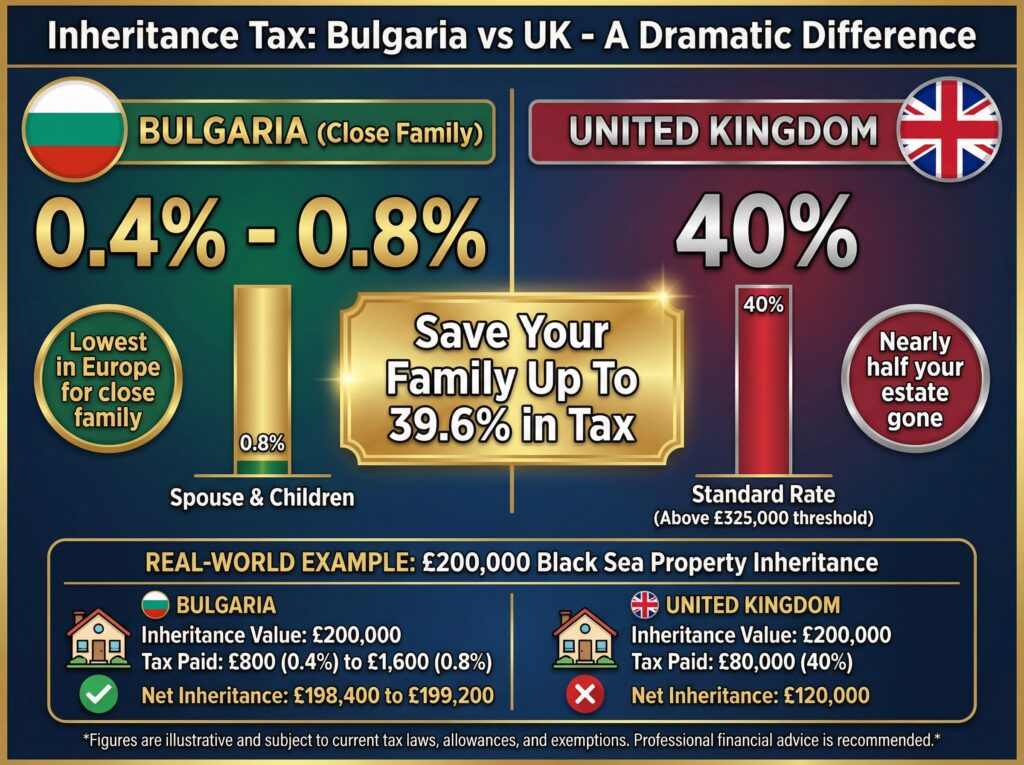
Bulgarian inheritance tax rates make British tax rates look positively medieval. Close relatives pay just 0.4% to 0.8% on inherited property. Compare that to the UK’s 40% inheritance tax rate, and Bulgaria starts looking very attractive.
The tax rates depend on your relationship to the deceased:
- Spouses and children: 0.4% to 0.8%
- Parents and siblings: 3.3% to 5%
- Other relatives: 5% to 6.6%
- Non-relatives: 6.6%
But here’s the catch – you might face tax in both countries. The UK could still want its slice if you’re a UK tax resident or if your total estate exceeds British thresholds. Double taxation treaties help, but they don’t eliminate all complications.
Smart estate planning can minimize these tax bills legally. Some retirees establish Bulgarian tax residency to take advantage of favorable local rates. Others structure their affairs to use both countries’ allowances effectively.
[Suggested data: Tax comparison chart showing inheritance tax rates in Bulgaria vs UK, with examples using different property values]
Joint Ownership Strategies for Couples
Joint ownership can be a powerful tool for British couples buying Bulgarian property. When one spouse dies, the property automatically passes to the survivor without going through inheritance procedures. It’s like having a fast-pass at the legal theme park.
Bulgaria recognizes two types of joint ownership: joint tenancy and tenancy in common. Joint tenancy means you both own the whole property together. When one dies, the survivor gets everything automatically. Tenancy in common means you each own a specific share that can be inherited separately.
Most British couples prefer joint tenancy for their Black Sea properties. It’s simpler and faster. No probate procedures. No inheritance tax on the first death. The surviving spouse can continue enjoying their retirement without legal headaches.
However, joint ownership isn’t always perfect. It can limit tax planning opportunities. It might conflict with children from previous marriages. And it doesn’t solve the problem of what happens when the second spouse dies.
[Suggested multimedia: Flowchart showing how joint ownership works vs individual ownership in inheritance scenarios]
Creating a Valid Will in Bulgaria
A Bulgarian will must meet specific local requirements to be legally valid, even if you already have a UK will. Many British retirees assume their UK will covers everything. That’s like bringing a cricket bat to a football match – technically it’s sports equipment, but it won’t help you score.
Bulgarian law recognizes three types of wills:
- Holographic wills: Handwritten and signed by you
- Public wills: Made before a notary with witnesses
- Secret wills: Sealed and deposited with a notary
For most British retirees, a public will offers the best protection. It’s harder to challenge, and the notary ensures it meets all legal requirements. Yes, it costs more upfront, but it saves your family from expensive court battles later.
Your Bulgarian will should specifically cover your Bulgarian assets. Don’t try to create one mega-will covering everything in both countries. Different legal systems don’t play nicely together. Keep it simple – Bulgarian will for Bulgarian property, UK will for UK assets.
[Suggested data: Statistics on will contests in Bulgaria, showing success rates for different types of wills]
Trust Structures and Estate Planning Options
Trusts aren’t as common in Bulgaria as they are in the UK, but they can still play a role in sophisticated estate planning. UK-based trusts can hold Bulgarian property, but they face complex tax and reporting requirements in both countries.
Some British retirees establish Bulgarian companies to hold their property. This can offer tax advantages and succession planning benefits. When you die, the company shares transfer according to your will, while the property stays in the company name. It’s like changing the driver without selling the car.
However, company ownership isn’t suitable for everyone. It adds complexity and ongoing costs. You’ll need annual filings, accounting, and professional management. For a simple retirement home, individual ownership usually makes more sense.
Another option is Bulgarian family foundations. These are relatively new legal structures that can hold assets for family benefit across generations. They’re more flexible than trusts but require careful setup and management.
[Suggested multimedia: Comparison table showing pros and cons of different ownership structures for Bulgarian property]
Common Inheritance Pitfalls to Avoid
The biggest mistake British retirees make is assuming UK inheritance law applies to their Bulgarian property. This leads to nasty surprises when family members discover they can’t inherit as expected. Don’t let your retirement dream become your family’s nightmare.
Many couples buy property in one spouse’s name to save money on legal fees. This seems smart until the named owner dies unexpectedly. Suddenly, the surviving spouse discovers they don’t automatically inherit. They might need to share with their deceased partner’s children from a previous marriage.
Another common trap: failing to update wills after buying Bulgarian property. Your 10-year-old UK will probably doesn’t mention your Varna apartment. This creates confusion and potential conflicts between different inheritance rules.
Some retirees try to avoid Bulgarian inheritance law by keeping property in UK company names. This can work, but it often creates more problems than it solves. UK companies holding Bulgarian property face complex reporting requirements and potential tax disadvantages.
[Suggested data: Case studies showing common inheritance problems and their solutions, anonymized but realistic examples]
Working with Bulgarian Legal Professionals
Finding the right Bulgarian lawyer is like finding a good doctor – you want someone who speaks your language and understands your situation. Many Bulgarian lawyers who work with British clients have UK legal training or extensive experience with international clients.
Look for lawyers who are members of the Bulgarian Bar Association and have specific experience with inheritance law. Ask for references from other British retirees. Check if they have professional indemnity insurance – it’s not always standard in Bulgaria.
Don’t be tempted to use the cheapest lawyer you can find. Inheritance law mistakes can cost your family thousands and create years of legal battles. A good lawyer pays for themselves by preventing problems before they occur.
Many British retirees benefit from working with both Bulgarian and UK lawyers who can coordinate their advice. This ensures your estate planning works effectively in both countries.
[Suggested multimedia: Checklist of questions to ask potential Bulgarian lawyers, with red flags to watch for]
Protecting Your Family’s Interests
The best inheritance protection starts before you buy property, not after you die. Smart British retirees build protection into their purchase structure from day one. This prevents problems rather than trying to fix them later.
Consider your family dynamics carefully. Do you have children from previous marriages? Are there potential conflicts between your spouse and your children? Will language barriers make inheritance procedures difficult for your family?
Regular reviews are essential. Bulgarian law changes, family circumstances evolve, and property values fluctuate. What made sense when you bought your Burgas retirement home might need updating five years later.
Communication is crucial. Make sure your family understands your plans and knows where to find important documents. Consider creating a simple guide explaining Bulgarian inheritance procedures in plain English. Your family will thank you for this thoughtfulness.
[Suggested data: Survey results showing how many expat families face inheritance problems due to poor planning]
Recent Changes in Bulgarian Inheritance Law
Bulgarian inheritance law has undergone several important updates in recent years. The 2023 amendments simplified some procedures for foreign heirs and reduced bureaucratic requirements. These changes generally benefit British retirees and their families.
One significant change affects property valuation for inheritance tax purposes. Previously, properties were often valued at outdated official assessments. Now, market values are used more frequently, which can increase tax bills but provides fairer treatment.
The digitalization of Bulgarian government services has also improved inheritance procedures. Many documents can now be obtained online, making the process easier for heirs living abroad. This is particularly helpful for British families dealing with Bulgarian inheritance from the UK.
EU inheritance regulation changes have also impacted how cross-border inheritances work. These generally make things smoother for EU citizens, though Brexit has created some new complications for British nationals.
[Suggested multimedia: Timeline showing recent changes in Bulgarian inheritance law and their impact on foreign property owners]
Planning for Healthcare and End-of-Life Decisions
Inheritance planning isn’t just about property – it’s about protecting yourself and your family during difficult times. Many British retirees in Bulgaria need to plan for healthcare decisions and end-of-life care as well as property inheritance.
Consider creating powers of attorney that work in both the UK and Bulgaria. This ensures someone can make decisions for you if you become incapacitated. Bulgarian healthcare powers of attorney differ from UK versions, so you might need separate documents.
Healthcare planning becomes more complex when you live abroad. Will you return to the UK for serious medical treatment? Do you want to remain in Bulgaria? These decisions affect your estate planning and inheritance arrangements.
Some British retirees establish healthcare funds specifically for end-of-life care in Bulgaria. This ensures they can afford quality care without depleting their inheritance. It also provides peace of mind for family members who might otherwise worry about care costs.
[Suggested data: Statistics on healthcare costs for end-of-life care in Bulgaria vs UK, showing potential savings and considerations]
Practical Steps for British Retirees
Start your inheritance planning before you buy Bulgarian property, not after. This gives you maximum flexibility and can save significant money. Once you own property, your options become more limited and expensive.
Here’s your action plan:
- Consult both Bulgarian and UK legal professionals before making any major decisions
- Review your existing UK will and consider whether you need separate Bulgarian documentation
- Understand the tax implications in both countries and plan accordingly
- Consider joint ownership if you’re married and want to simplify succession
- Keep detailed records of all property documents and legal arrangements
Regular reviews are essential. Plan to revisit your inheritance arrangements every three to five years or after major life changes. Marriage, divorce, births, and deaths all affect your planning needs.
Document everything clearly and keep copies in both countries. Your family shouldn’t need to become international detectives to sort out your affairs.
[Suggested multimedia: Step-by-step checklist for inheritance planning, with estimated timeframes and costs for each step]
The Role of Professional Estate Planning
Professional estate planning isn’t just for millionaires – it’s essential for any British retiree owning Bulgarian property. The cost of proper planning is typically far less than the problems it prevents. Think of it as insurance for your family’s future.
Good estate planning coordinates your UK and Bulgarian affairs seamlessly. It minimizes taxes legally, prevents family conflicts, and ensures your wishes are followed. Most importantly, it gives you peace of mind to enjoy your retirement.
Many British retirees benefit from annual estate planning reviews. These catch problems early and adapt to changing circumstances. They also ensure your planning stays current with law changes in both countries.
Consider the total cost of not planning properly. Legal battles, unnecessary taxes, family conflicts, and bureaucratic delays can easily cost more than professional planning. Your family deserves better than that legacy.
[Suggested data: Comparison of estate planning costs vs potential inheritance problems costs, showing the financial benefits of proper planning]
Living Comfortably While Planning Ahead
Inheritance planning shouldn’t dominate your retirement years. The goal is to handle these matters efficiently so you can focus on enjoying your Bulgarian lifestyle. Good planning happens in the background while you live in the foreground.
Many British retirees find that sorting out inheritance matters actually improves their retirement experience. They feel more secure knowing their affairs are in order. They can focus on exploring Varna’s cultural offerings or enjoying the walkable neighborhoods without worrying about legal complications.
The expat community can be a valuable resource for practical advice. Other British retirees have faced similar challenges and can share their experiences. Just remember that everyone’s situation is different – what worked for your neighbor might not work for you.
Consider whether you want year-round residence or seasonal living. This affects your tax planning and inheritance arrangements. Both options can work well with proper planning.
[Suggested multimedia: Photos of British retirees enjoying life in Bulgaria, showing the lifestyle benefits that good planning helps protect]
Conclusion
Bulgarian inheritance laws don’t have to be a source of stress for British retirees. With proper understanding and planning, you can protect your Black Sea property investment while ensuring your family’s future security.
The key points to remember: Bulgaria follows forced heirship rules that protect family members. Foreign property owners have the same rights as locals. Inheritance taxes are generally lower than UK rates. Joint ownership and proper wills can simplify succession. Professional legal help is essential for complex situations.
Take action now, not later. Start with a consultation with qualified legal professionals in both countries. Review your existing arrangements and identify any gaps. Consider how your Bulgarian property fits into your overall estate planning strategy.
Your Bulgarian retirement dream can become a lasting legacy for your family. But only if you plan properly from the start. Don’t let legal complications overshadow the joy of owning property in this beautiful country.
The safety and security you’ve found in Bulgaria can extend to your family’s future too. With proper inheritance planning, your Black Sea property becomes more than just a retirement home – it becomes a protected family asset for generations to come.
Ready to secure your family’s future? Find Your Perfect Bulgarian Property and start your inheritance planning journey today.